There are many skills a façade engineer should have. You have to be creative and practical. In order to become a good facade engineer, it is basicly to get experience in every stage: design, calculations, tests, standards, on site, schedules and budget.

In the following list I describe the main skills from my point of view:

-To visualize every component which forms the envelope. It means that you have to imagine the anchorage, structure, fillings and final elements. It is essential to be able to construct the whole façade in your mind before doing any sketch.
-Every design ought to be possible to assembly on site. You can not design something if you don’t know how to assembly on site.
-To understand the functions of every element and how can they play the best role according to the architectural project specifications.
-To have a deep knowledge of the concepts relationed to energy and light performances; water, thermal, acoustic and fire isolation.
-To make good sketches.
-To calculate inertia of profiles and to optimize it.
-As a engineer, you have to offer the best technical solution at the optimal cost. You can not design something if you don’t know how much does it cost.
-Good communication skills are essential in order to attend meetings and to write technical reports.

Said that, I present an interesting interview published in The Independent a years ago to John Champion, a façade engineer and technical director of James&Taylor firm. He explains his opinion about this job.

What does a façade engineer do?

I work with architects and builders to create the façade, or outer skin, of a building. Most buildings have a steel or concrete frame, plus a weatherproof layer on top. The very outer bit of that weatherproof layer – the bit that looks good – is the façade. The nice thing about my job is that I get to influence its design, form, and appearance. If an architect has an off-the-wall idea, but doesn’t know how to turn it into reality, we get called in.

What’s your working pattern like?

Theoretically, the hours are 9.30am to 5.30pm. But because of deadlines, we usually work much longer. A typical project might start with a meeting with the architects and client to look at various models and drawings. After whittling down various proposals, we mock them up, ending up with one or two versions. The next stage is critical: we construct a large-scale prototype, two or three storeys high, so everyone can stand back and get a perspective of what it might look like from 100m away. It either works, or it doesn’t. Then it’s a question of logistics – ordering materials, producing drawings for builders and overseeing construction on-site.

What do you love about it?

My favourite thing is playing a part in creating something that looks terrific. I worked on the futuristic Selfridges in Birmingham, and the New Museum of Contemporary Art in New York, which looks like a huge pile of boxes balanced on top of each other. You can stand back on a street corner, look up at an iconic 23-storey building that started as a scribble on an architect’s piece of paper and think, “I did that”.

What’s not so greatabout it?

Dealing with people who don’t care. Sometimes you get involved in projects that aren’t overtly well-designed, and end up working with a team that doesn’t care what the building looks like – they just want it to work. We want it to work and look terrific too. If everything was simply built to the lowest functional denominator, it would be pretty sad.

What skills do you need to do the job well?

You need to be a good engineer, to understand the principles of contemporary construction and be extremely thorough and practical. You can’t design something if you don’t know how to bolt it together yourself. If you’re talking to a guy on a scaffold, he won’t buy what you’re saying if you haven’t ever wielded a spanner, so it helps to have a solid background in construction. Being able to communicate well is important – you’ve got to be able to get your point across, whether you’re talking to a room of 30 people, meeting an architect, or sitting down with a group of builders.

What advice would you give someone with their eye on your job?

The key thing is to choose the company you work with carefully – look at whether they do interesting work. Get into the technical and design department and show you’re willing to roll your sleeves up and get stuck in. Ideally, you should try to get an engineering qualification and brush up your skills in computer-aided design. The days of the cigarette packet sketch are long gone, so you need to be pretty hot on computer skills. Companies look for people with an eye for good design and a fixation with all things mechanical – I used to spend hours making Meccano models as a child.

What’s the salary and career path like?

Starting out in the technical department of most engineering and construction firms, you might earn about £30,000 a year. You could specialise in a particular area of construction, and work your way up through the management levels if that’s what you’re interested in.

Source: renatocilento.blogspot.com

Repost from the GKD pressroom
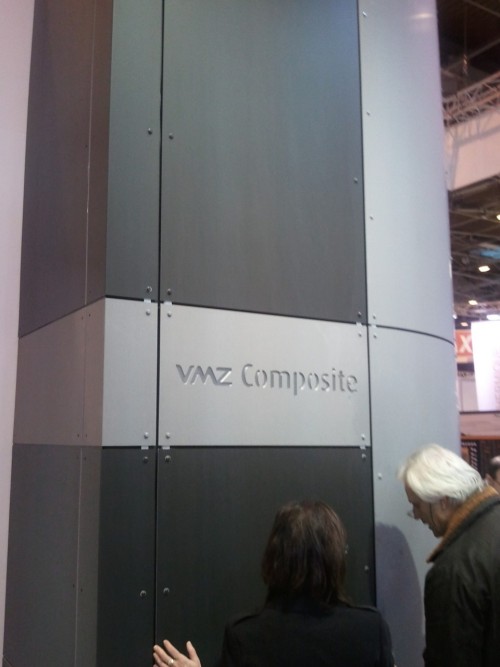
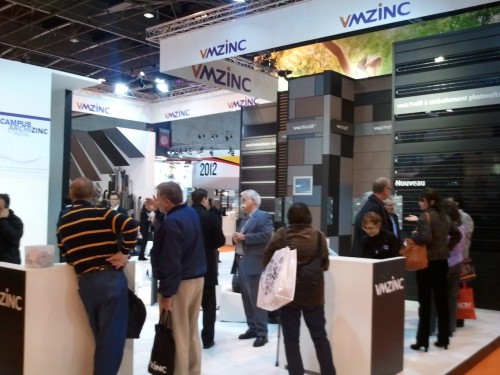
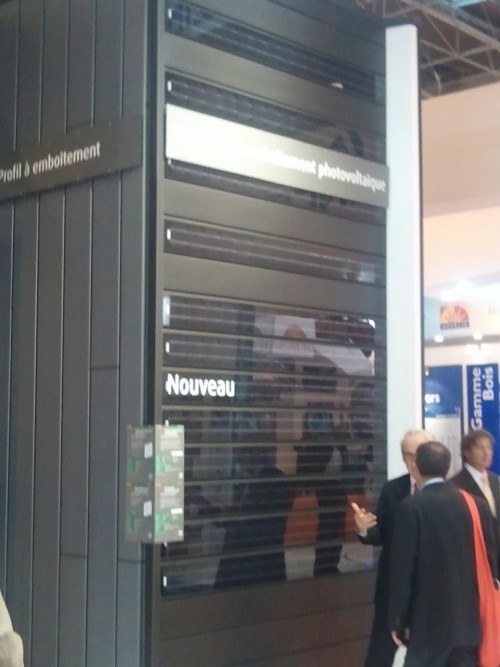
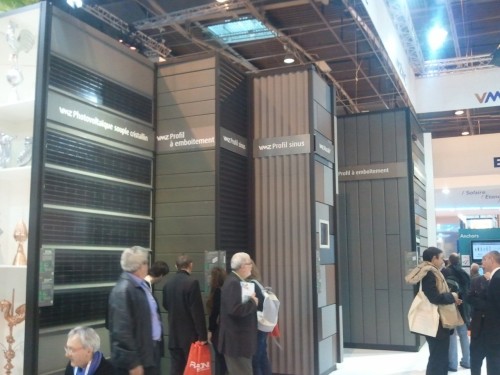
travelogue part three -days three and four &  even more food: day three simply rocked!  our little group of north americans (for now we had canadians among us), went to the big batimat show and gazed in wide wonder at our company’s booth.  that sounds like hyperbole and company pride, and granted, there was some of that, but in reality, this booth was huge!  just as a way of comparison, this booth had a coat room, a wet-bar, and an upstairs lounge.  (yeah, a lounge…upstairs)  ornaments hand-wrought from zinc, composite zinc, dri-design (www.dri-design.com) panels in zinc, solar on zinc, and rainwater goods (gutters and downspouts) made out of zinc, were just some of the contenders begging for some eye-time. 

the thing about batimat is that it is a huge show.  when a company exhibits there, they want (and need) to bring their a-game.  it is definitely go big or go home.  the other related thing about batimat is that if a company does not “go big,” they will be hard press to garner attention.  this is due simply to size.  this show is a weight loss program waiting to happen.  once again, every two years this show takes place.  we recommend it highly. 

after the show, and after losing about five solid pounds due to the march in, around, up and down the batimat show, we got together for a little dinner cruise up and down the seine -well, not all 482 miles of it, but the parts in and around paris landmarks.  what can you say about the way the french cook?  how about, oh la la, these people can cook. the weight lost was easily restored.   

day four brought about a free day for our batimat contingency.  participants could wander the city, go back to the show, sleep late, order room service or do whatever they liked.  the only contingency was that our group had to meet either in the lobby of our hotel in the early evening hours, or meet us in the lobby of the louvre a half-an-hour later. 

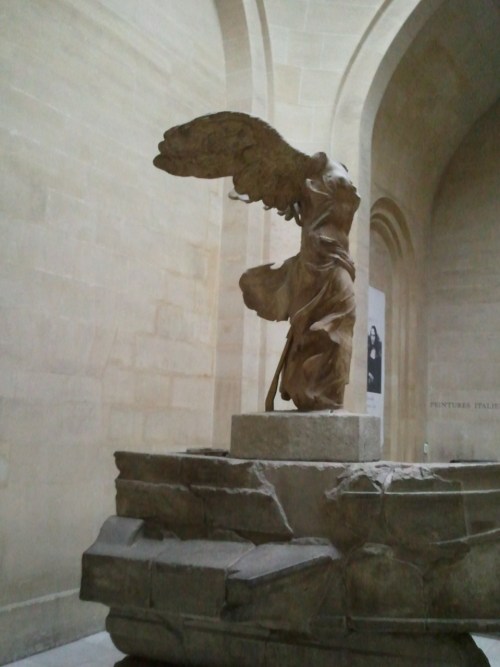
at every batimat show, the fine folks at vmzinc put together an event that we call “international night.”  during international night, attendees from around the world get together for a meal, conversation and some fun.  two years ago, this meant cooking class and a meal with french chefs aboard yachts on the seine.  this year it meant a scavenger type of hunt, followed by dinner and drinks -both events held in the louvre in the evening.  to say that it was over the top to have access to so many areas of the museum, and then to enjoy a fine meal inside of the louvre would be an understatement.  it was blissful. 

it gives us great pleasure to work for and with so many great people who know how to provide exceptional products coupled with a great sense of living and having fun.  we want to thank our reps and additional guests that attended this year and thank those that have attended in the past.  we also enjoyed seeing our french hosts and friends (more like family)once again.  we hope to see you, the reader, at a future show.  that would rock! -vm

Source: www.zincsense.com

repost from www.zincsense.com

The aim of this article is to explain the difference between two glass curving technologies: hot bending and cold bending.
Hot bending technology is based upon the following basic process [1]: a flat sheet of glass is placed upon a mould that has the desired bending radius and is heated evenly to temperature of 650ºC. At this temperature the glass changes to a visco-plastic state, loses its brittleness and stiffness, and can, therefore, be shaped by gravity or mechanical pressure, obtaining the aimed geometry by cooling.
Hot bending allows a broad variety of geometries and compositions -cylinders, s-curves, double curved shapes-  to be achieved. The sheets are bent and then can be laminated and/or assembled into insulating glass units.
Manufacturers are steadily investigating, testing and, if the market demands it, expanding the manufacturing limits of radius, angle, thickness, girth and coatings, in order to offer architects and designers the largest sizes and greatest possibilities.
It is feasible in many cases to use coatings and ceramic frits in concave and convex sides, though the selection can be limited depending on varying factors such as glass thickness, size, radius, location adjacent to interlayers.
In order to attain a spherical, double curved and free form geometry with large deflections, curves with small radius such as 100 mm, processing with high temperatures is required.
 Curved annealed laminated glass with a solar control and frit used on 40 Bond Street project, New York, 2006; Architect: Herzog & de Meuron (Produced by Cricursa, who have been bending glass since 1928)
Cold bending is a recent fabrication process. Flat glass panes are brought to the desired geometry by means of external contact pressure, which demands holding the curved glass unit in desired form.
Two basic techniques are used here: the glass can be curved at the construction site (and held in place by clamping strips) or  curved in factory before laminating (and held in place by the interlayer).
The company seele sedak has been instrumental in the development of a new lamination bending technology [2], which consists on using shear stiff laminates, to produce extreme large bent glass panels.
The Lamination process of cold bent glass can be divided into four basic steps [2]:
1.- Put together interlayers and flat glass, usually tempered. The glass can also be heat strengthened, annealed, with ceramic frits or coatings though these may affect the limits of what is possible.
2.- The glass is formed into the desired shape by physically pressing it onto the laminating framework and clamped into place.
3.- Lamination process, the aim is to achieve a high shear bond between the glass and the interlayer.
4.- Release from the scaffold form. During and after the lamination process, high quality control and observance of the stresses in the single panes due to the spring back effect is necessary. It is required to increase the curvature in the panel during the lamination process to get the exact shape after releasing the laminated panel from the framework.

Both technologies provide fully bespoke, custom design solutions and the research and testing ensures the success of the most innovative designs. 
Bridge made of cold-shaped glass and spanning seven metres (by seele sedak, Glasstec 2008)
[1] Cricursa General catalogue
[2] Bruno Kassnel-Henneberg, seele sedak. Purely structural glass building envelopes (Glass Performance Days 2011)

With editing by charles.bostick@seele.com

Source: renatocilento.blogspot.com

Repost from the GKD pressroom
Levolux, the market leader in Solar Shading, is the driving force behind sustainability at Volvo’s Maidstone dealership, Lipscomb Motors, with an innovative and sustainable timber Fin Solar Shading system. The architect, Bisset Adams, required a solution that fitted perfectly with the bold Scandinavian image it had developed for Volvo dealerships across the country. Levolux responded by designing and manufacturing a bespoke system using the African hardwood Idigbo, as specified by the architect on the basis of the material’s environmental credentials. To access this case study visit http://tinyurl.com/3c4uzny

301242_10150379891461208_229985451207_10472718_1956241637_n.jpg

Richard H. Talaske, Talaske|Sound Thinking, acoustical consultant on the project indicated “Jazz in New Orleans is a mix of acoustic and amplified music. At the new Ellis Marsalis Center for Music, the hall needed to accommodate both, with only limited adjustable acoustics capability. We felt that sound diffusing finishes on strategic surfaces was the right design approach. For our past projects, RPG’s undulating product designs offered effective diffusion with excellent timbre of sound. Hence, we specified RPG again for Ellis.”Repost from RPG Facebook page

post3.jpg

When you have your own business, your boss is the most demanding one: The Market. Only if you offer competitive and innovative products, the market will award you. This is the case of Buryat ( htt://www.buryat.es ), a catalan company located in Barcelona, which is specialized in rockwool technical solutions for fire insulation integrated in curtain wall systems. They invest efforts to improve their products according to the observation market needs. They are putting some shine on two issues: minimize the number of pieces and reduce the assembly time.

All of their systems are tested in laboratory according to the European Standards.

The new version of Buryat EI120, as solution for 1 meter fringe between slab concrete and curtain wall, is formed by four elements:
? High density rockwool insulation panel of 50 mm thickness.
? Espiga ACR: anchorage between panels.
? Square profile: anchorage for horizontal panel on the lower slab side.
? Angled: anchorage for vertical panel internal aluminium frame.

The system is formed by a rockwool vertical panel inside the aluminium frame, afterwards two horizontal panel situated one on the top and one on the lower side slab. The lower panel is anchoraged to the slab through the square profile. The top panel is fixed between the concrete slab and vertical panel.
The rockwool panels are anchoraged to the concrete slab, in order to achieve the independence between fire insulation system and curtain wall.

Finally, in order to protect the vertical aluminium profiles of the lower part, a new rockwool panel is assemblied to the vertical one through the Espiga anchorage. In the upper part, the same rockwool panel is assemblied and anchoraged to the vertical panel through Espiga anchorage.
The free spaces between the rockwool panels and the slab concrete must be filled with intumescent sealants.

The isolant fire integrated in a curtain wall have been tested in laboratory and the result is 120 minuts of stability and integrity.


Source: renatocilento.blogspot.com

Repost from the GKD pressroom
The aim of this post is to present one of the celebrities in the engineering and facade world. It is a introduction to those who are unaware of Peter Rice’s achievements.

This great engineer contributed in facades and structures with such a important innovations. He cooperated to design buildings, nowadays considered icons of structures and façades.

Currenlty the most of façades designed and built, in some way contain his essence.

He set up as Structural Engineer in Ove Arup  firm from 1956 to 1977, afterwards he founded his own engineering firm, partnering with Martin Francis and Ian Ritchie.

The following points enhance some of the most important ideas of his philosophy and way of thinking:

-He believed the best buildings are the result of a symbiotic relationship between the architect and the engineer, where the engineer is the objective inventor and the architect the creative input.
-He was convinced that there was nothing mysterious about the process of innovation. He was never satisfied with mundane solutions. He took risks during the early stages of the design process.
– He combined advanced structural analysis techniques with investigations of materials in order to achieve the best structural systems.
– Peter confessed to learn just what he needed to know when he needed it.

According to Rice, the roles of the engineer are:

-To use the engineer’s understanding of materials and structure to make real the architectural designs.
-To innovate and to support the creativity of architects.

Among the most renowned construction he was involved in, we can mention the following:

-Sydney Opera House (1973, Jorn Utzon)

-Louvre Pyramid (Paris, 1988, Ming Pei)

-Lloyd’s of London (London, 1986, Richard Rogers)

-Stansted London Airport (1991)

-Cité des Sciences at La Villette (Paris,1987,Adrien Fainsilber)

The Centre Pompidou adopted the gerberette solution to achieve the long spans required to support a heavy library that could be moved anywhere in the building. One of Peter’s main contributions was his insistence on the use of cast steel for these pieces. The gerberette acted as a short beam propped on a circular column and tied down at the ened with a circular bar.

The curtain wall in the Cité des Sciences at La Villette has been the origin of the inexhaustible source of inspiration for the point-supported glass facades worlwide. The main innovations are:

-Drilled glass panels with countersunk holes for point fixings supports.
-Spherical bearings keeps all loads in the glass plane and eliminate local bending effects.
-Horizontal cable trusses resists out-of-plane wind forces.

In 1992 he was awarded the Royal Gold Metal for Architecture by the Royal Institute of British Architects for his achievements which let the advancement of architectures.

In 1994, the Harvard University established the Peter Rice Prize in recognition of the ideals and principles that he represented.

After his death, the engineering and architecture have lost one of their innovation engines.

It is advisable to read his two books: Structural Glass (Peter Rice, Hugh Dutton) and
An Engineer Imagines (Peter Rice).

Source: renatocilento.blogspot.com

Repost from the GKD pressroom
Structural glass symbolizes modern architecture and it is considered an added value to achieve all glass facade and non-metal supported transparent structures.

The prospect of shapping glass has contributed to attain a broad variety of aesthetical and structural options through oversized pieces of glass with complex geometries. Its versatility has allowed to achieve a better integration between the aesthetic and functional objectives.

The Casa da Musica in Porto (Rem Koolhas, 2004) is an example how to make the best of curved glass, because glass develops both functions: structure and enclosure. The glass shape increases the set stiffness and it is not necessary any metallic frame. Glass is anchoraged at the top and at the bottom part of its 6 meters length.

In glass bending technology, one distinguishes between hot-bending and cool-bending. Hot-bending consists on bending glass at high temperatures, being the most common manufacture method. On the other hand, cold
bending can be done in two modes: bending during the assembly at the construction site or laminated bendsare done in factory, both cases, the glass are brought to the desired shape by means of external contact pressure.

In order to achieve double-curved, spherical, curves with small radius and complex geometries, high temperatures are recquired during the manufacture process.

This post is under construction. In fact, it will be under construction during a long time. Creativity  is the limit, because curved glass contributes with the facades of the future.

Source: renatocilento.blogspot.com

Repost from the GKD pressroom